
Discuss releases, compare workflow ideas, and get help from the community.
>>> discord.gg/JbWScy4y9K
RASEN▌
Not a circle — a spiral.
Intent is where you start. The spiral is how you get there.
package@atelierai/rasennpm
version0.1.7read at build time
licenseMITOpenSpec + Sayo
lineageOpenSpecFission-AI, forked
One session, one command.
You: /rasen-auto full-feature I want dark mode but I'm not sure how to do it cleanly.
AI:  Pipeline: full-feature (explicit)
     First stage: office-hours. Let's pressure-test the design.
AI:  First load-bearing fork: one shared token layer, or theme logic
     repeated inside components? I recommend CSS variables: less drift.
     Choose the shared token layer?
You: Yes — use one shared token layer.
AI:  Next fork: follow the system theme by default, with a saved manual
     override? I recommend yes; it stays predictable and dependency-free.
     Approve that direction?
You: Yes — approved.
AI:  Design approved. Wrote the office-hours design document.
     ✓ office-hours — direction approved and recorded
     LEAD continued the full-feature pipeline with role-isolated workers.
     ✓ propose — intent captured as change artifacts
     ✓ apply — dark mode implemented
     ✓ expert reviews — review, design review, and QA passed
     ✓ review-cycle — one finding fixed; re-review clean
     ✓ ship — delivery recorded
     ✓ retain — durable lessons evaluated
     ✓ archive — specs synced
     Done. Dark mode is shipped.
Rasen (螺旋) is the shape of a loop that climbs.
That is the whole idea, and it maps onto how the tool actually works.
01
>>>Intent is the origin.
Every change begins with what you want, not a document you have to write — a goal, a bug, a feature request. The harness captures it in your rasen/ workspace and gets to work: /rasen-propose → /rasen-apply-change → /rasen-archive-change. The spec it produces along the way is the pipeline's own working memory — knowledge that accretes with every change — not homework handed back to you.
02
>>>Loops are the form.
Work moves in cycles, not one waterfall pass. The rasen pipeline family — small-feature, bug-fix, full-feature, auto-decompose — turns a task into a shaped loop of propose, implement, review, ship.
03
>>>Each turn ascends.
The harness doesn't just repeat; it makes progress. /rasen-auto runs a LEAD that orchestrates role-isolated subagents, a review-cycle that catches its own mistakes, and handoff/relay that carries context across sessions — so every turn ends higher than it began.
04
>>>Until it breaks through.
/rasen-goal closes the spiral on a condition, not a document: drive a metric to a target, make a module rubric-clean, research until a brief is answered — repeat modify → judge until the gate is met.
From intent to evidence,
one outer loop.
workflow
Intent-driven workflow
Tell it what to build. The harness turns that into a proposal, spec, design, and task list, then maintains them while it works: /rasen-propose → /rasen-apply-change → /rasen-archive-change.
pipelines
Installable pipeline library
Inspect, import, export, validate, and assemble YAML pipelines. Dependencies install with the workflows that need them.
autopilot
/rasen-auto
One command turns the agent into a LEAD that orchestrates role-isolated subagents (planner / implementer / reviewer / fixer / shipper) through the pipeline, pausing only at gates.
goal loops
/rasen-goal
A sibling to /rasen-auto for tasks whose "done" is a condition, not a document. The LEAD classifies into measure / evaluate / research and repeats modify → judge until the gate is satisfied or the round cap is hit.
spaces
Projects + stores
Scope every page from the URL, keep worktrees under one project, and inherit configuration through project → store → global layers.
keepalive
Prompt-cache continuity
Park an idle Claude worker on a bounded keepalive beat so a role switch does not silently pay for a full-context rewrite.
continuity
Context sensing & handoff
rasen agent context measures real occupancy; /rasen-handoff writes a distillate checkpoint; workers self-hand-off at soft budgets, so long runs survive context limits.
audit
Local token forensics
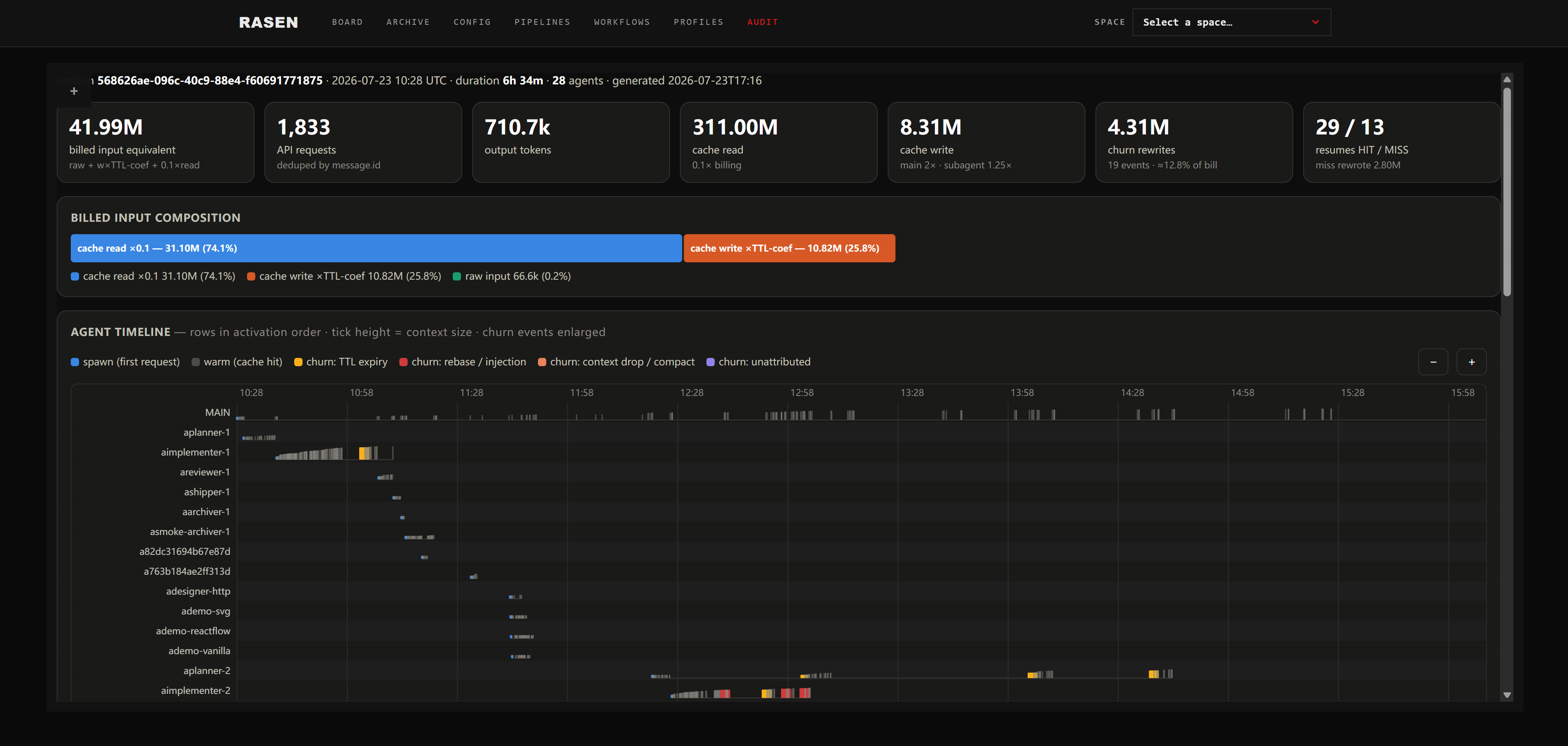
rasen agent audit attributes spend and cache churn across Claude transcripts and Codex rollouts, with a bundled HTML viewer.
See the whole spiral.
Intervene where it matters.
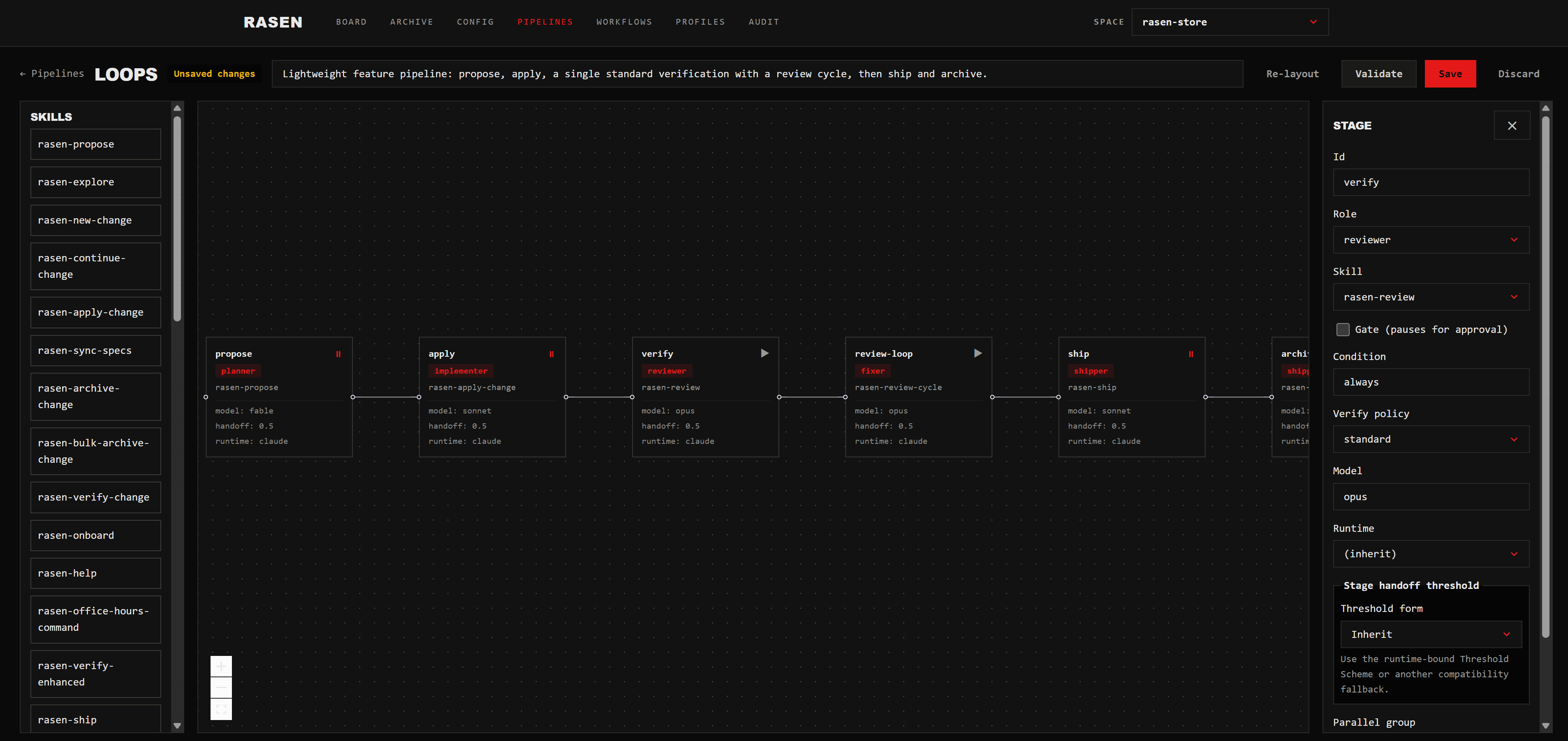
Rasen 0.1.5 adds an optional browser-based management platform served by a local daemon. Explore Board/Spaces, assemble and validate pipelines, tune configuration, and inspect local audit evidence — bound to 127.0.0.1 and protected by a per-session token.
RASEN UI / LOCAL CONTROL PLANE
DAEMON · 127.0.0.1
BOARD / SPACES
Work is visible as Tasks.
PLANBUILDREVIEWSHIP
management-platform releaseGATE · REVIEW
PIPELINE / DAG
Assemble the outer loop.
drag skills · connect dependencies · validate · save
spaces + archiveOne portfolio, every project.
Switch between projects and stores, search completed Tasks, and keep worktrees grouped with their project.
config + libraryControl what each space inherits.
Inspect Global, Store, and Project values; manage workflows, profiles, and pipeline stage settings.
cache disciplineKeep parked workers warm.
rasen agent wait preserves Claude prompt-cache continuity across review-loop role switches.
local auditSee where the tokens went.
rasen agent audit explains spend and cache churn locally. Nothing is uploaded.
Start with the CLI.
Add the control plane.
Requires Node.js >= 20.19.0. The CLI is required; @atelierai/rasen-ui is optional and adds the local management platform.
npm i -g @atelierai/rasen
cd your-project && rasen init
npm i -g @atelierai/rasen-ui && rasen ui
rasen init creates a rasen/ workspace and installs Rasen skills for your AI coding tool. Run rasen update after upgrading to refresh those skills. rasen ui starts or adopts the local daemon and opens the optional browser UI.
Choose a channel.
Keep the spiral moving.
Ask questions, compare workflows, and share what you are building with other Rasen users.
QQ
Join the QQ group
Open the group link to join the conversation.
- Group number
- 1087505735
Independent namespaces, zero collision.
Rasen is forked from OpenSpec (MIT) by Fission-AI and is independently maintained by Sayo. It is not affiliated with Fission-AI. Workflow semantics are aligned with upstream OpenSpec v1.5.0 — the propose → apply → archive model is the same — but rasen runs in independent namespaces, so both can be installed in the same project at the same time.
surface
openspec
rasen
Binary
openspec
rasen
Agent skills
openspec-*
rasen-*
Workspace
openspec/
rasen/
If you have an existing openspec/ workspace, rasen migrate is copy-only: it copies openspec/{specs,changes,config.yaml} into rasen/, skipping anything that already exists. Your original openspec/ directory is never modified or deleted.